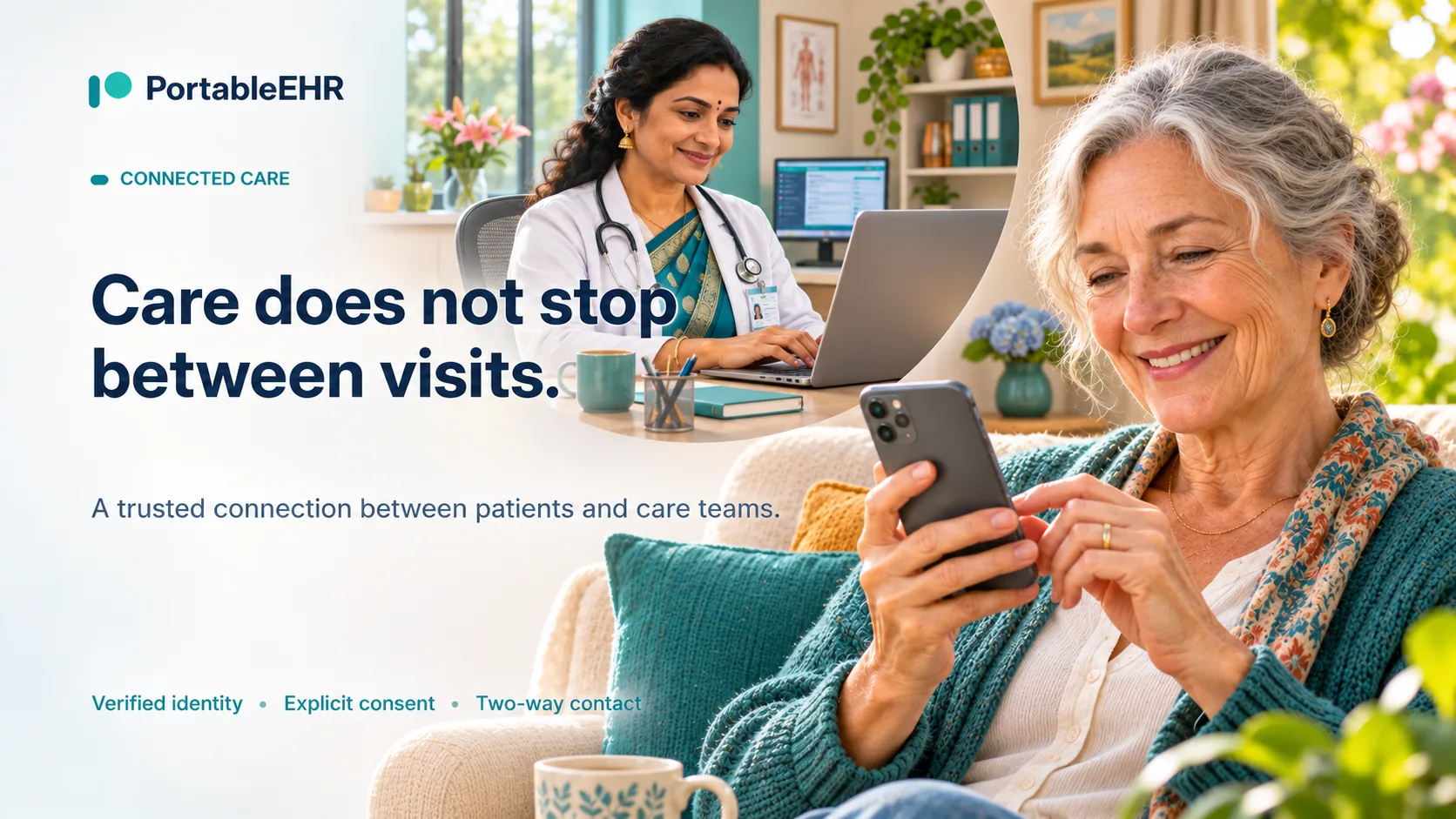
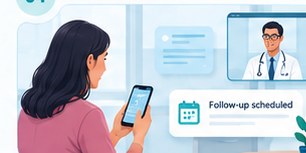
Clinical context changes. Care decisions should keep up.
PortableEHR maintains a secure, patient-controlled communication channel so that authorized care teams can ask what has changed, receive attributable responses and provide documented follow-up — without replacing their existing clinical systems.
Preserve what was known. Discover what has changed.
Native iOS and Android apps. US Patent 12,406,076 B2. Works with your existing systems.
An authenticated relationship with the patient can continue beyond appointments.
What makes clinical dialogue possible
Verified Identity
Know who you are talking to and be able to attribute the response to an authenticated person.
Explicit consent
Respect the patient’s authority over access, participants and permitted communications.
Two-way communication
Ask the right questions, receive a response and document what has changed.
The smartphone is a physical possession factor linked to a previously verified identity and to session authentication. Owning a phone is not, on its own, proof of a person’s identity.
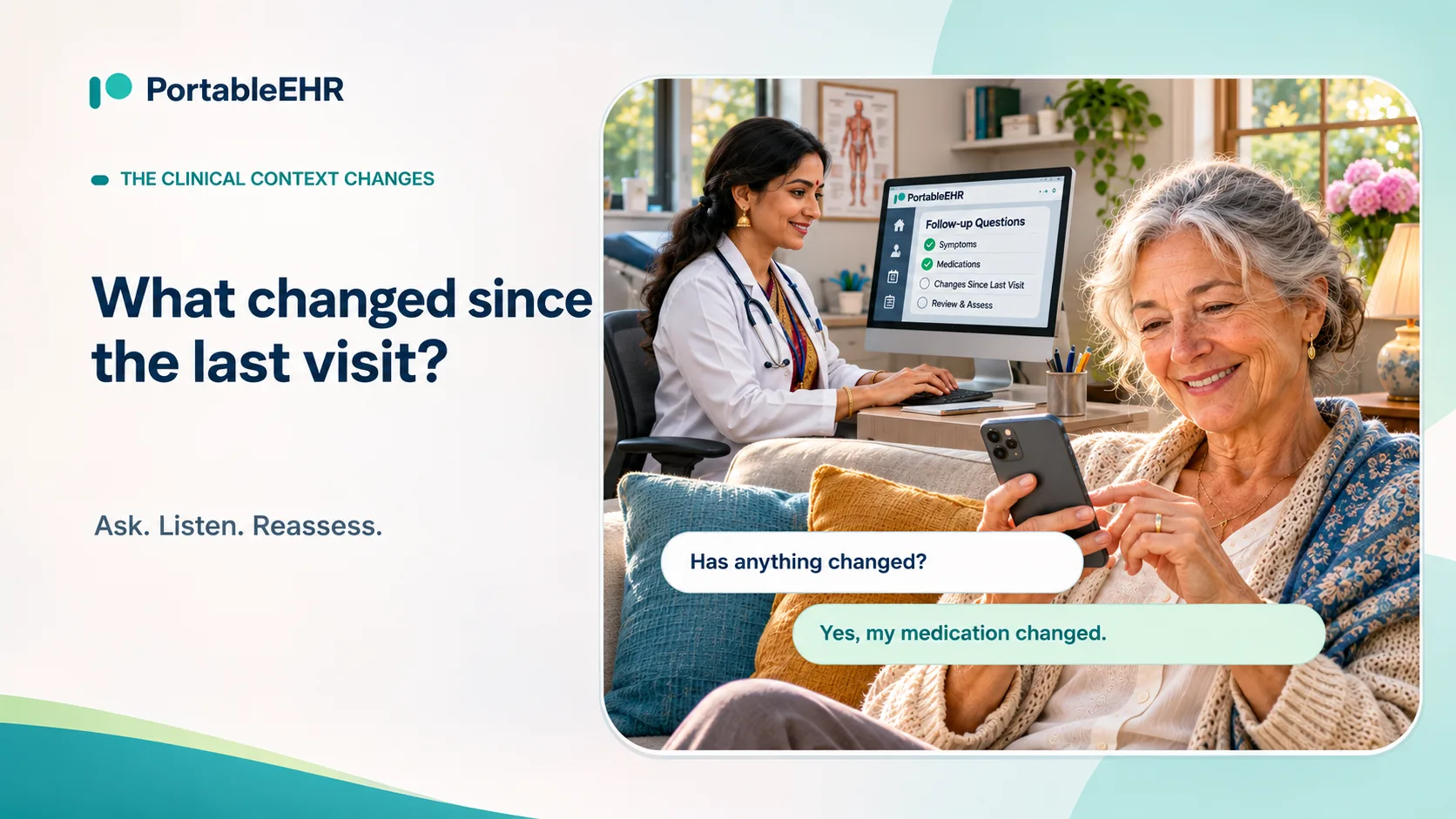
What has changed since the last visit?
Between appointments, a treatment may be stopped, a symptom may appear or another professional may become involved. The record from the last visit does not necessarily describe today’s situation.
PortableEHR allows an authorized team to recontact the patient, ask a targeted question and document the response with its provenance and timeline. The professional can then reassess the context before moving forward with decisions.
The response is attributable and dated; it must then be assessed by the professional.
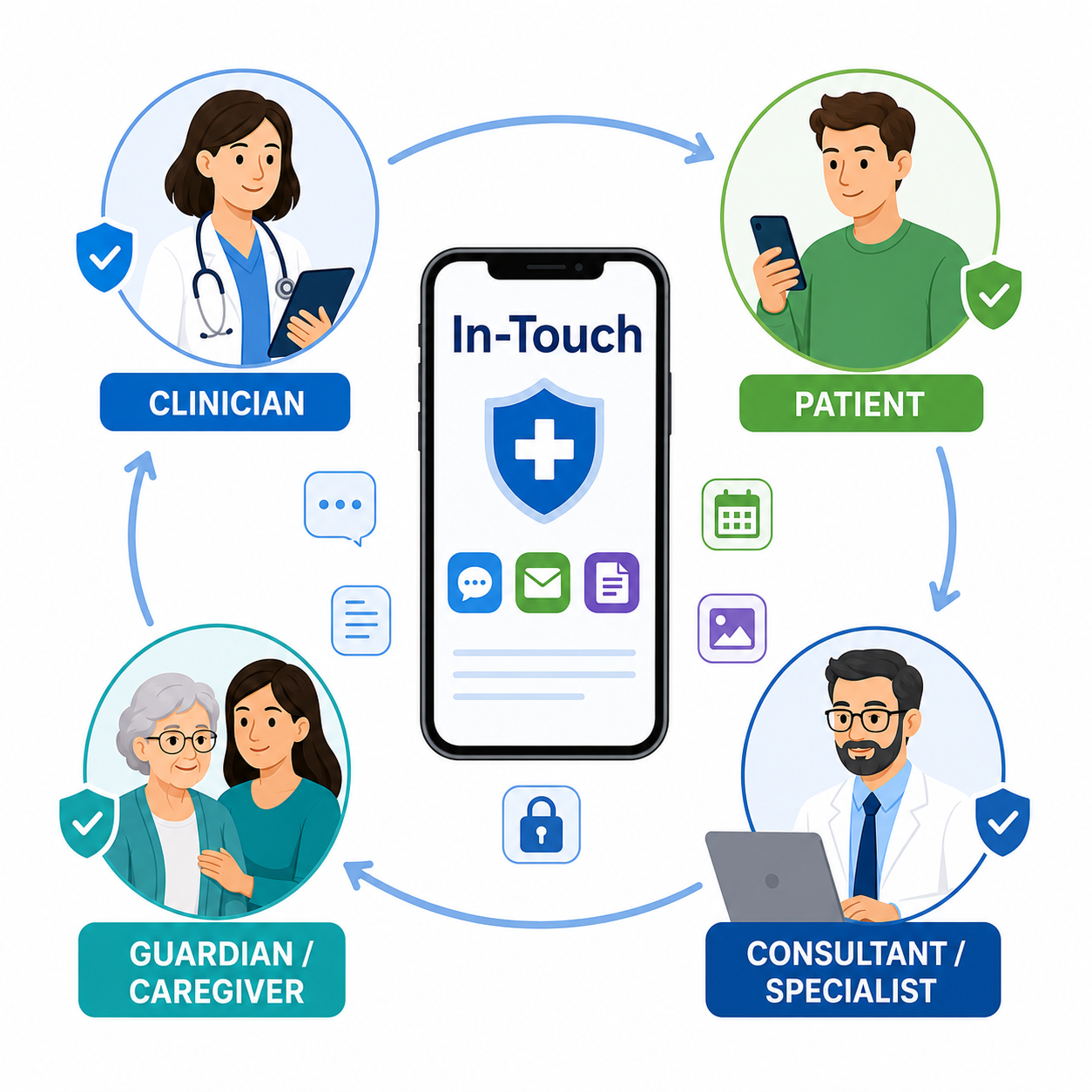
InTouch: the clinical conversation continues
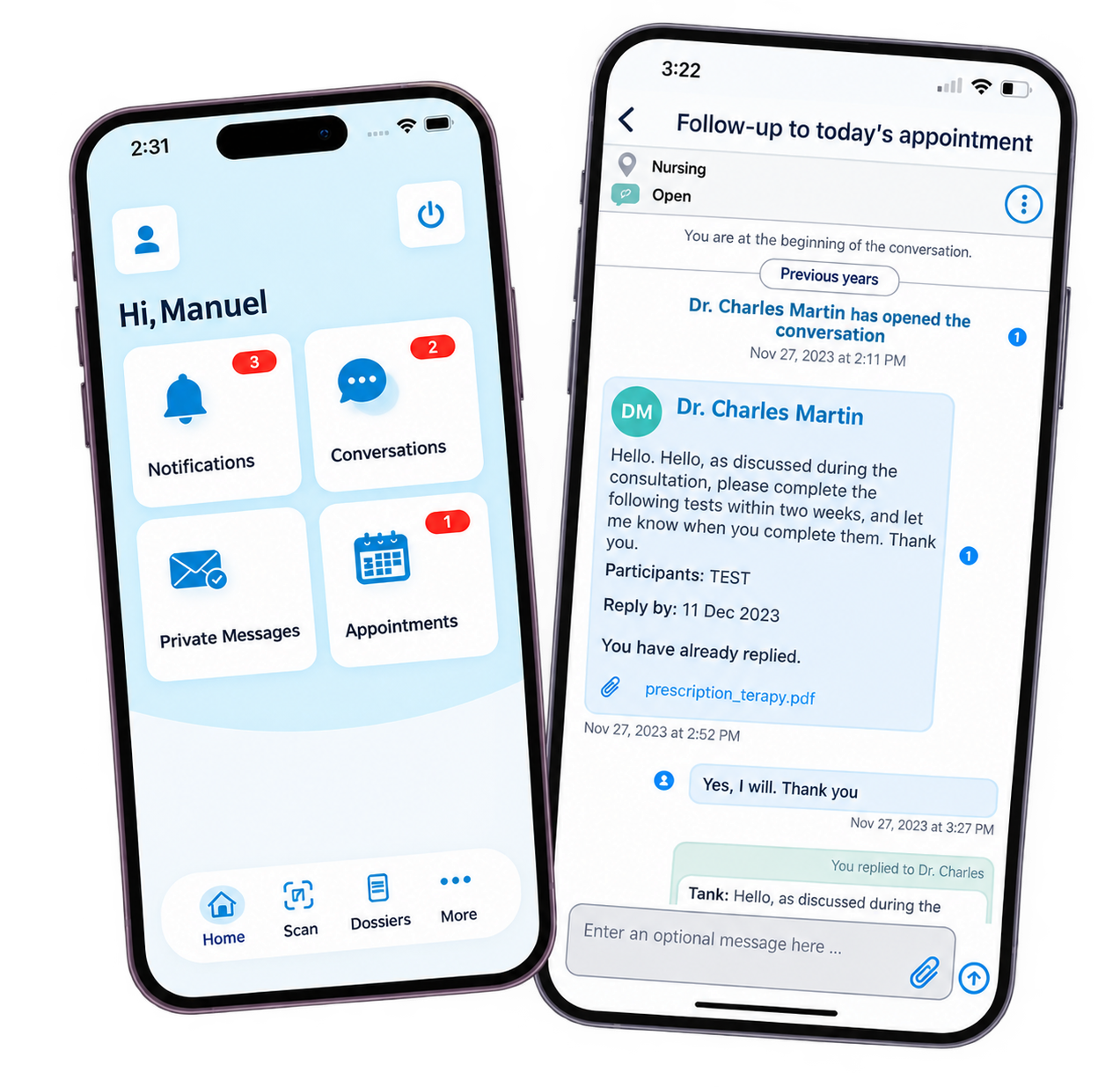
Follow-up questions, documents, images and responses can flow between authorized participants in secure, traceable exchanges. The conversation does not have to end at the clinic door.
Actual InTouch screens: home view (left) and a secure request-and-reply conversation (right). Select a screen to enlarge.
One patient. Several teams. A relationship that continues.
Information and responsibilities are spread across independent organizations. PortableEHR helps authorized participants coordinate and continue their exchanges without requiring them to replace their clinical records.
When healthcare organizations need to coordinate care
A family physician refers a patient to a specialist at another clinic. Instead of relying on disconnected fax, email, or paper workflows, participating organizations can use InTouch to support secure communication, authorized information exchange, and traceable follow-up. Each organization retains its existing clinical systems while PortableEHR supports trusted interactions across organizational boundaries.
01
Family clinic
Physician initiates a referral or request
02
InTouch secure exchange
Authorized request and information, in a traceable thread
Illustrative flow between participating organizations onboarded to InTouch. Each clinic keeps its own clinical system.
Fewer fragmented channels
Less reliance on fax, email, and paper where InTouch is deployed.
Clearer requests and replies
A defined route for authorized requests, responses, and follow-up.
Patient-linked accountability
Identity, authority, consent, revocation, and auditable interactions.
Works with existing systems
No forced EHR replacement. Efficiency gains are measured in a pilot.
Deployment details
Secure exchanges are provided between participating organizations. Integrations with electronic medical records and certain advanced features depend on the systems involved and on the scope agreed for each deployment.
A patient visits a new specialist
A patient can verify their identity and authorize sharing of relevant information with a new specialist, where the required system connections are available.
Workflow conditions
Sharing depends on available connections and on the permissions granted by the patient. Each organization keeps its own clinical records.
A family member joins in care
A patient can nominate a trusted care collaborator and define the permissions for that person’s participation, with the ability to revoke those permissions.
Workflow conditions
Care collaboration is not the same as legal guardianship, and doesn’t carry the same authority.
A physician reconnects with a patient
After a consultation, discharge or treatment abroad, InTouch can support authenticated communication that continues beyond the original encounter.
Workflow conditions
Follow-up happens within the patient’s permissions and applicable rules.
Screen shown: an InTouch follow-up conversation. Select it to enlarge.
The trust foundations behind continuity of care
Identity
Identify and authenticate participants.
Authority
Determine who can act for or represent a person.
Consent
Define and withdraw the appropriate permissions.
Participation
Include authorized people according to their role.
Communication
Maintain a secure two-way dialogue.
Traceability
Document exchanges, their timeline and their attribution.
These capabilities are not an end in themselves: they make possible a care relationship that is legitimate, lasting and able to renew itself.
PATIENT-CONTROLLED
One individual
Across care settings
01
Identity
Verify who the individual is
02
Authorization
Set who may access, act, or communicate
03
Controlled Interaction
Exchange information only within granted permissions
04
Audit / Revocation
Review a traceable activity history and withdraw permission where supported
Participating hospital
Participating clinic
Participating specialist
Each organization retains its own clinical records. PortableEHR complements existing systems.
The patient-centered trust layer supports authorized interactions across independent healthcare organizations.
Better-connected care teams. Patients who keep their authority.
Let’s discuss a concrete case where communication and recontact could improve continuity of care in your organization.
Pilots are scoped jointly around an agreed workflow and measurable success criteria.
Pilot terms
Integration requirements are defined per pilot. Participating organizations must onboard to InTouch. Operational benefits are hypotheses until quantified in a pilot; no cost savings are guaranteed.